
The technology behind subsurface clarity
Three layers, one platform — XWI, our next-generation Full Waveform Inversion engine; Nebula, the cloud platform that runs and monitors every job; and XWAI, the AI copilot that lets your whole team work with the results in plain language.
Three layers, one platform
From the physics that builds the model, to the cloud that runs it, to the copilot that makes it conversational — each layer is built for the same goal: clearer, deeper, faster subsurface imaging.
XWI
A proprietary, cloud-native Full Waveform Inversion engine — a full suite of FWI, PSDM and PSTM for land & marine, 2D & 3D data, built to overcome the limits of conventional methods.
Explore the X-Wave EngineThe platformNebula
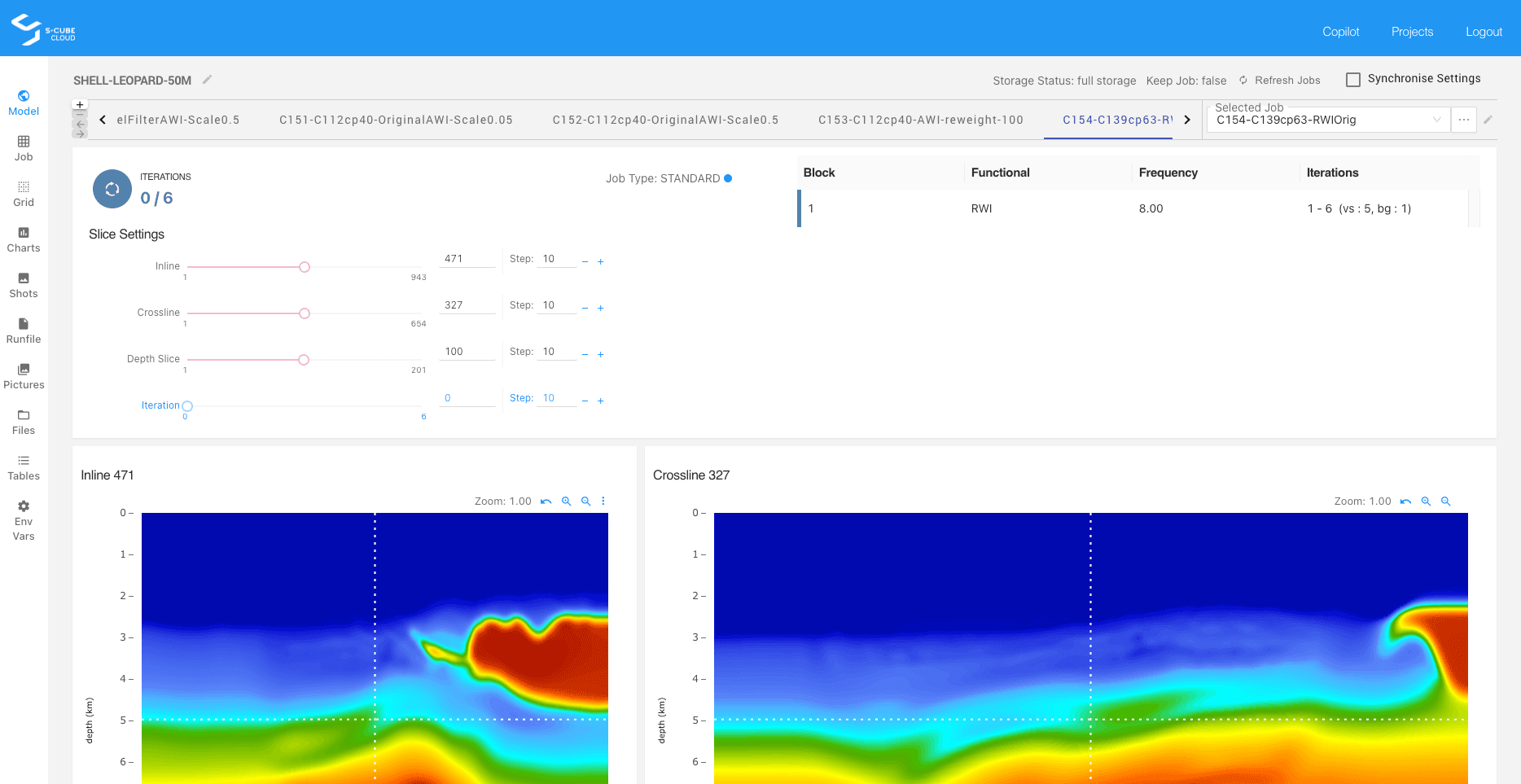
The cloud dashboard that runs every job and keeps you in control — monitoring status, performance and QC outputs for immediate, data-driven decisioning.
See the Nebula dashboardThe copilotXWAI
XWI builds the models — XWAI is how everyone works with them. An AI agent that navigates your projects, jobs and results in plain language, grounded in your data.
Meet XWAIPowered by the X-Wave Engine
TSL-FWI is not just another FWI algorithm — it's a proprietary, cloud-native platform with a full suite of FWI, PSDM and PSTM capabilities for land & marine, 2D & 3D data.
Cloud Native & HPC Optimised
Fault-tolerant, cloud-native communications with instant spot reclaims — deployable on any HPC infrastructure, CPU (x86, ARM) and GPU (NVIDIA, AMD).
Advanced Physics
Elastic or visco-acoustic anisotropic modeling for land or marine, 3D or 2D.
AI-Accelerated, Metric-Driven
Automated inversion parameters and simultaneous velocity–reflectivity inversion in a unified feedback loop — faster, more accurate results.
Multi-Objective XWI
X for any objective function — adaptive, reflective or conventional — plus impedance inversions for RTM-like images from raw, unprocessed data.
Imaging & Data Products
FWI-derived reflectivity and AVA volumes, Kirchhoff Pre-Stack Time/Depth Migrations and advanced Reverse Time Migration (RTM).
Model Building & Conditioning
Constrained tomography, multi-dimensional interpolation & regularization (2D–5D), and superior noise & multiple attenuation.
A Multi-Objective Function Inversion Sequence
XWI — X for any given objective function: adaptive, reflective or conventional. Adaptive Waveform Inversion (AWI), Reflection Waveform Inversion (RWI) and their constrained variants combine into a single sequence that inverts velocity and reflectivity simultaneously, in one unified feedback loop.
- Adaptive Waveform Inversion (AWI)
- Reflection Waveform Inversion (RWI)
- Constrained AWI for salt & complex starts
- Simultaneous velocity + reflectivity
- Impedance inversion from raw data
- Cycle-skip resistant, low-frequency driven
Sharper images in the world's hardest basins
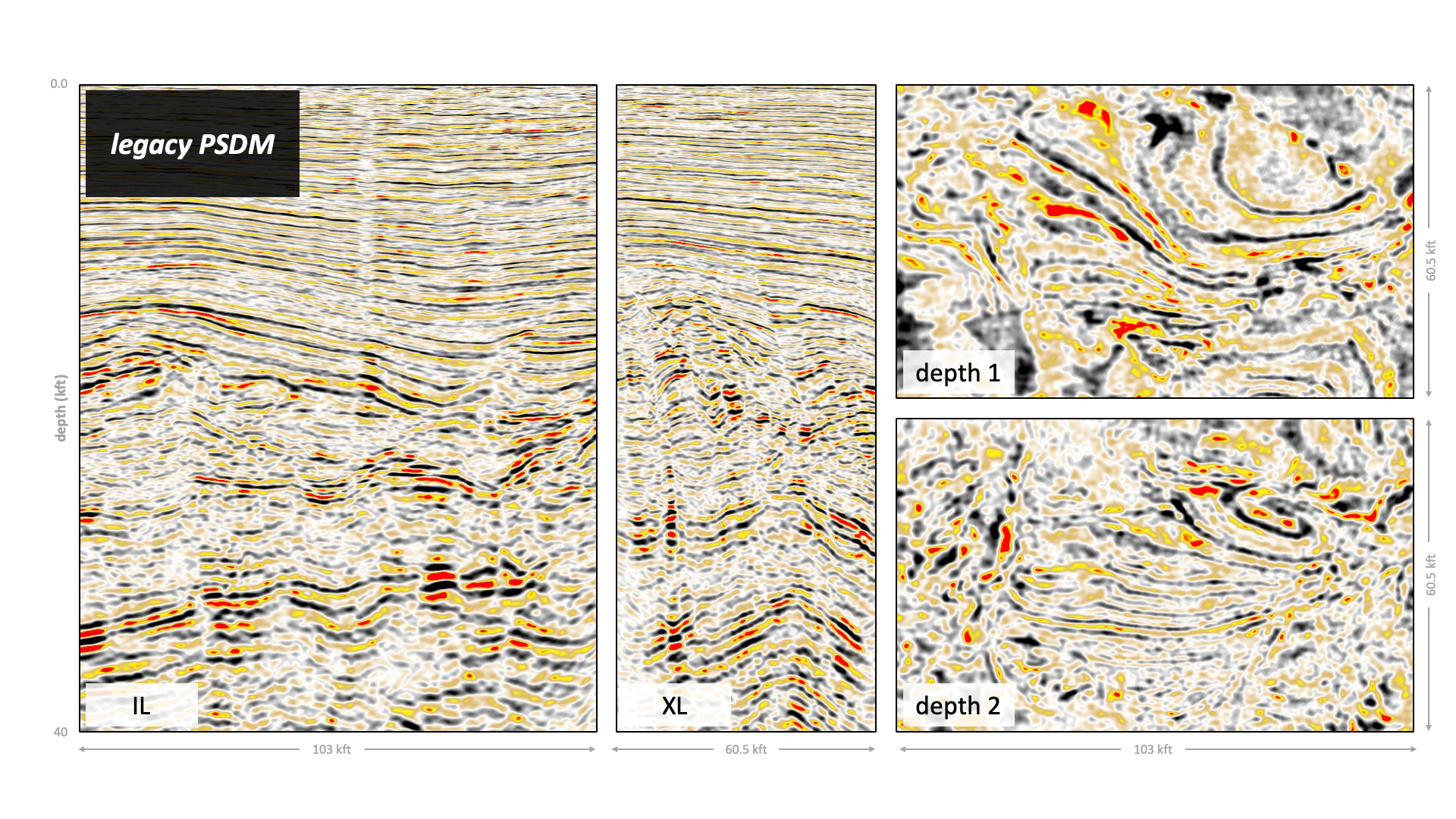
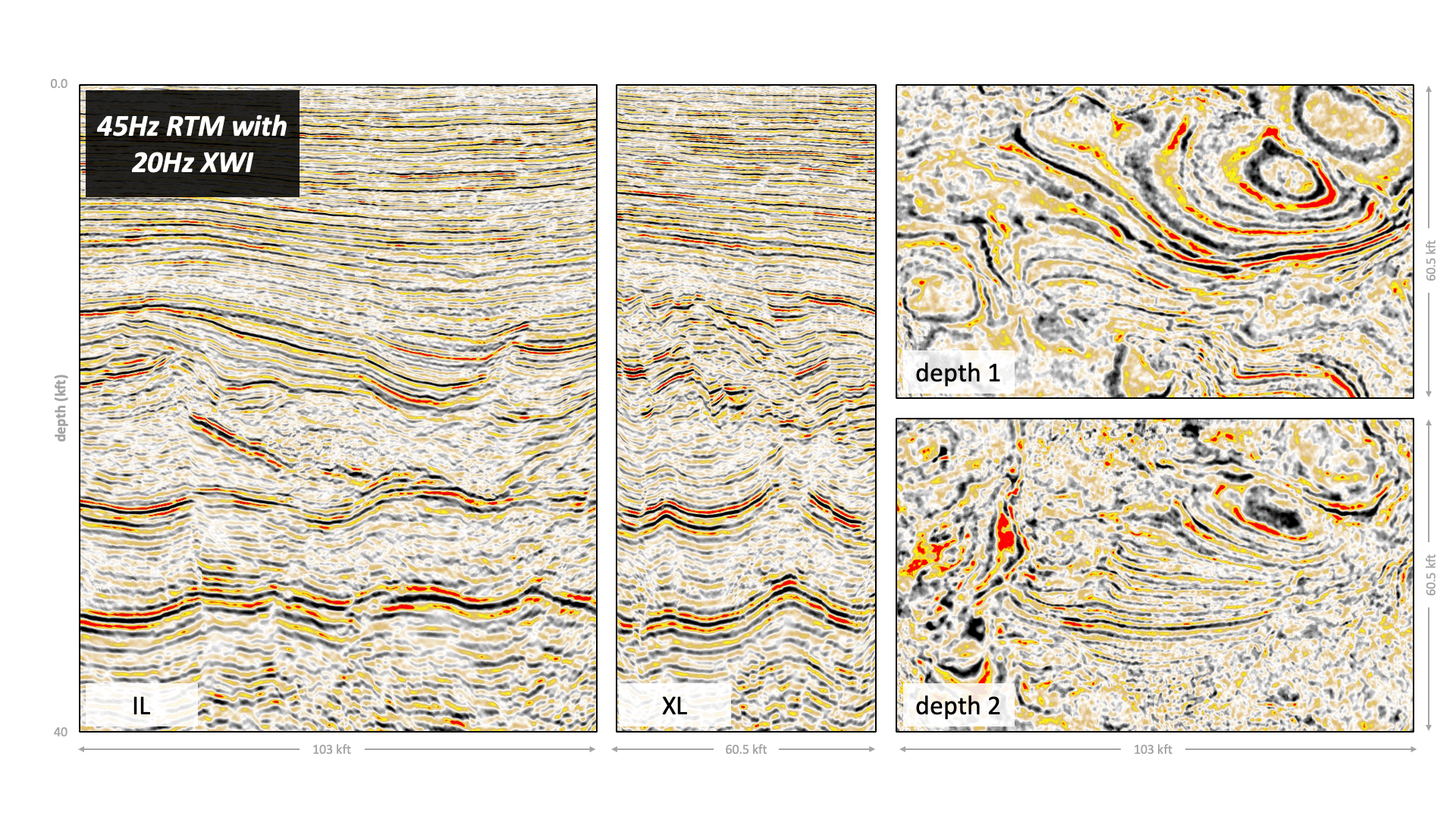
Consistent, high-impact results across complex basins globally — from vintage onshore data to deep-water sub-salt. Drag the slider to compare a legacy image with the same section re-imaged by XWI.
From field data to angle-dependent reflectivity
One integrated sequence runs on cloud-native infrastructure — from data preparation through to quantitative-ready outputs. Here is the land FWI workflow, end to end.
Data preparation
Statics · denoise · source extraction
Solve refraction statics, denoise coherent and incoherent noise, and extract per-shot wavelets — all conditioned for FWI.
Anisotropy
FWI-derived Vnmo and η
Invert anisotropic parameters directly from the data for a self-consistent model that flattens gathers and improves positioning at depth.
Velocity updates
TSL-FWI™ objective functions
A family of FWI objective functions built for land — robust to near-surface heterogeneity and unmodelled amplitudes, exploiting low frequencies from the first iteration.
Inverted reflectivity
FWI-derived reflectivity & marker mistie
Generate FWI-derived reflectivity straight from the converged elastic model, tied to well markers and quantifying mistie.
Angle-dependent FDR
Angle-dependent FWI-derived reflectivity
Retain AVA information for quantitative interpretation — a high-resolution alternative to angle gathers from migration.
XWI builds the models. XWAI is how everyone works with them.
The AI agent built into S-Cube's platform. Ask XWAI to navigate your inversion sequences, compare job parameters, pull cost and runtime data, render model slices, and answer methodology questions — all in plain language, grounded in your actual project data.
 Your AI inversion copilot
Grounded in your data
Connected to your projects, jobs and knowledge base — every answer comes from your actual data, not generic guidance.
Plain-language workflows
Navigate sequences, compare parameters, pull cost and runtime, and render model slices — all through conversation.
Wired into the platform
When a view needs the full dashboard, XWAI hands you a one-click deep-link to the exact job, shot or trace-fit plot.
Everything you need, one conversation away
XWAI is connected to your projects, jobs, and knowledge base — so every answer is grounded in your actual data, not generic guidance.
Project & Sequence Navigation
Lock onto any project and instantly retrieve its full inversion sequence — AWI, RWI, TSL-AWI steps and all. XWAI reads your project description so you never have to hunt through docs.
Job Discovery & Filtering
Find, filter, and cross-reference jobs across complex sequences and job groups in plain language. Narrow by functional type, frequency, mask, or any parameter — and refine on the fly.
Parameter Comparison
Ask XWAI to compare a set of jobs and it generates a clean parameter table showing only what differs — frequencies, functionals, masks, densities, mutes, tiletraces, and more.
Cost & Runtime Reporting
Pull cumulative runtime and AWS cost — total or broken down per iteration — for any job or selection. Know exactly what a run cost before planning the next one.
Visual Model Comparison
Request any inline or crossline slice of one or more velocity models and XWAI renders them side-by-side — across sequence steps and iterations — so you can see how the model evolved.
Shot & Gather QC
Inspect predicted versus field data at any shot. XWAI surfaces shot gathers and predicted-data panels so you can QC the fit in the data domain, not just the model.
Convergence & Trace-Fit Charts
Plot trace-fit convergence across iterations right in the chat. Compare how competing jobs converged and spot stalls or gains at a glance — no spreadsheet required.
Dashboard Deep-Links
When a view needs the full platform, XWAI hands you a one-click deep-link straight to the right dashboard page — the exact job, shot, or trace-fit plot, already loaded.
Knowledge-Base Q&A
Ask technical methodology questions — AWI, RWI, TSL-AWI, cycle skipping — and get answers grounded in S-Cube's internal knowledge base with cited source documents.
Stay in control with Nebula
A cloud dashboard that monitors job status, performance and QC outputs for immediate, data-driven decisioning — with XWAI built in as its conversational layer.
Job monitoring
Track status, runtime and cloud cost across every job and inversion sequence as they run.
Shot & gather QC
A dedicated Shots page surfaces predicted vs field shot gathers so you can QC the fit in the data domain.
Trace-fit comparison
Toggle the plot by iteration, inline, crossline or offset to see how the trace fit varies across the survey.
Convergence tracking
Follow trace-fit convergence across iterations and compare how competing jobs converged at a glance.
Depth-slice QC maps
Inspect depth-slice maps with shot positions coloured by trace fit, overlaid on the evolving model.
XWAI deep-links
XWAI is built in as the conversational layer — one click from a chat to the exact job, shot or plot, already loaded.
See the platform in action
From the X-Wave Engine to XWAI and the Nebula dashboard — see how S-Cube delivers clearer, deeper imaging on your data.