
Onshore FWI in India: S-Cube & ONGC Recognised at SEG Bengaluru for Bengal Basin Results
September 27, 2026
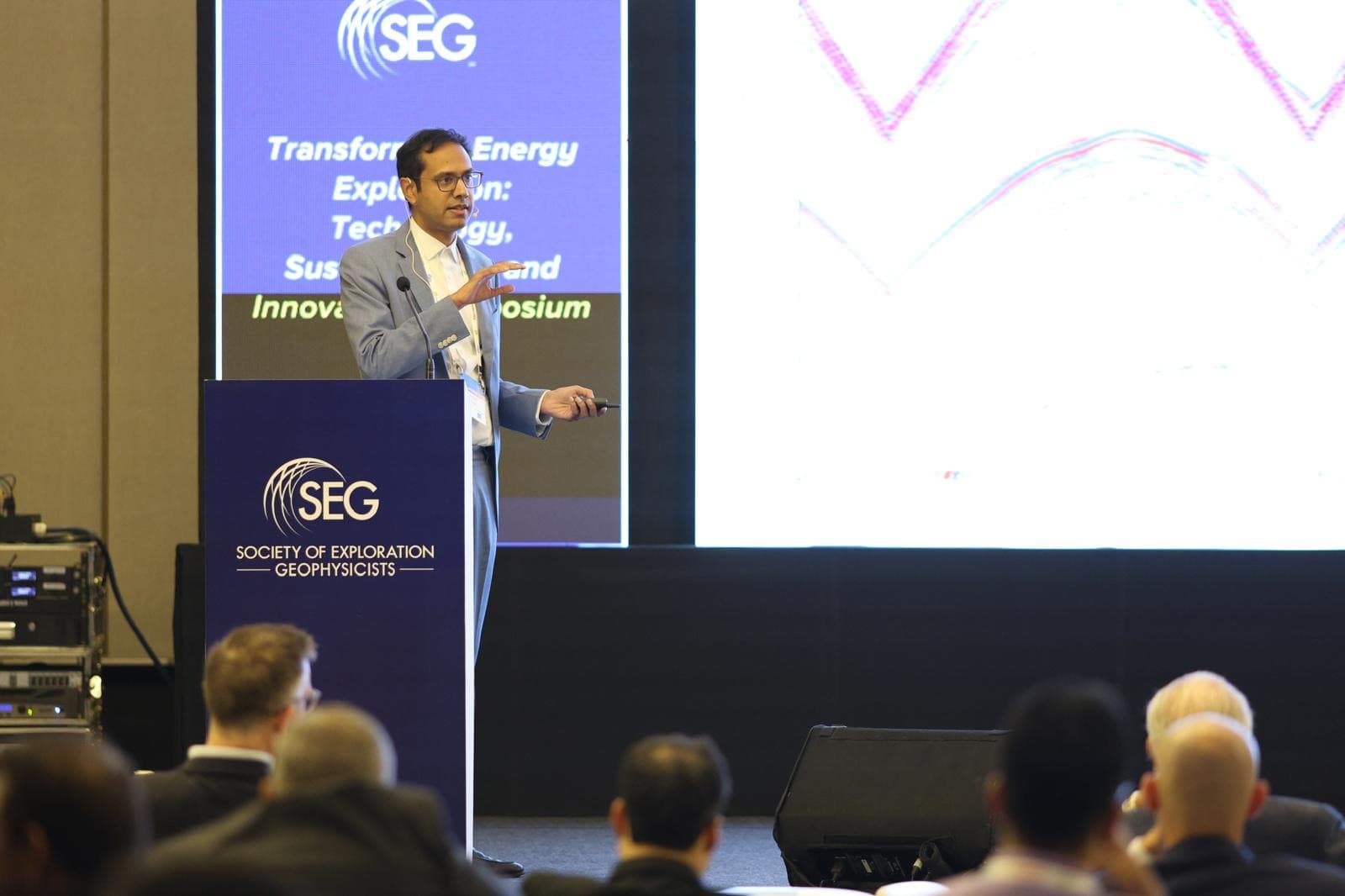
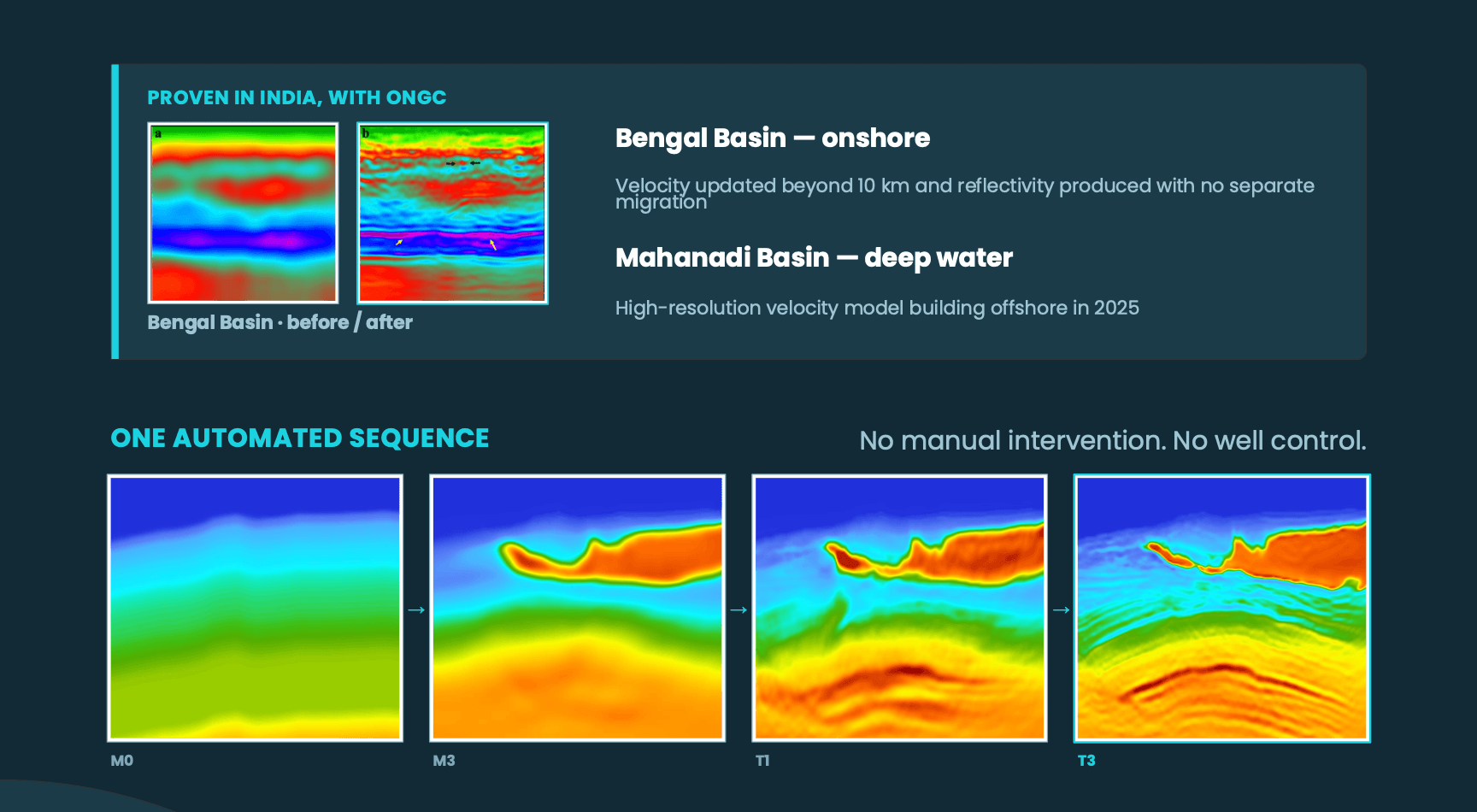
At the SEG Transforming Energy Exploration: Technology, Sustainability, and Innovation Symposium in Bengaluru, S-Cube and ONGC (GEOPIC) presented full waveform inversion (FWI) results from onshore India: a legacy dynamite survey in the Bengal Basin, inverted with Time-Space-Lag FWI (TSL-FWI™) to update velocity below 6 km. Alongside it, the team showed the offshore Mahanadi Basin results that preceded the land project.
These are the first FWI results shown on real Indian field data, onshore and offshore, and they are being used to guide ONGC's exploration and development decisions in both basins.
Read the paper
Land Seismic Full-Waveform Inversion for Simultaneous Velocity and Reflectivity Estimation: A Case Study from the Bengal Basin, India (PDF, SEG 2026)
Speakers recognised by SEG
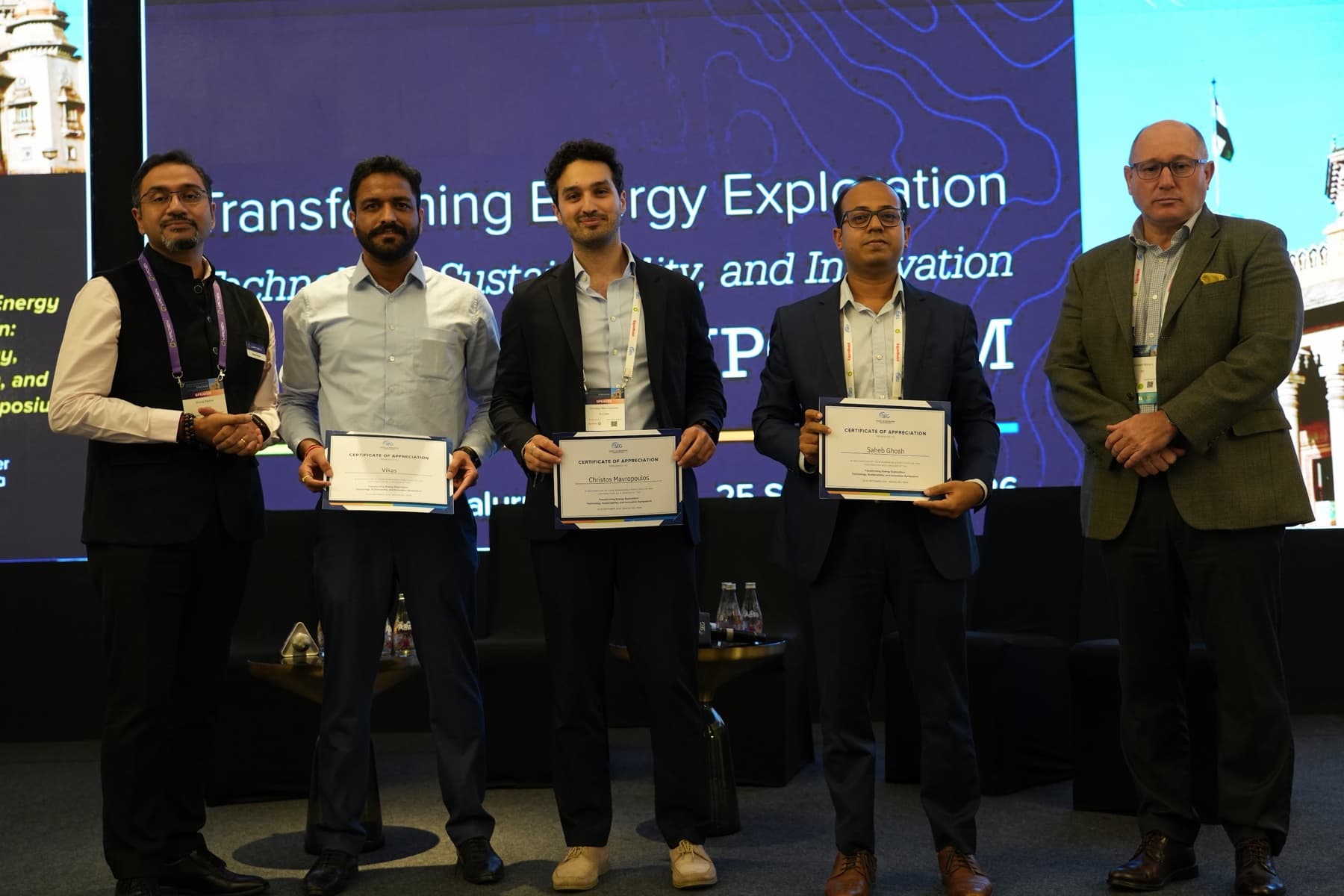
Vikas Vats (S-Cube), Christos Mavropoulos (S-Cube) and Saheb Ghosh (ONGC-GEOPIC) each received an SEG Certificate of Appreciation for their talks and for their work bringing FWI to Indian land data. Saheb Ghosh presented the Bengal Basin case study, Christos Mavropoulos covered how TSL-FWI™ changes onshore velocity model building, and Vikas Vats showed how FWI holds up away from well control.
Nikhil Shah (S-Cube) was also recognised by SEG for his keynote, Next Generation FWI for Land and Marine Applications, which presented the Mahanadi Basin results shown below.
Onshore Bengal Basin: deep velocity from a legacy dynamite survey
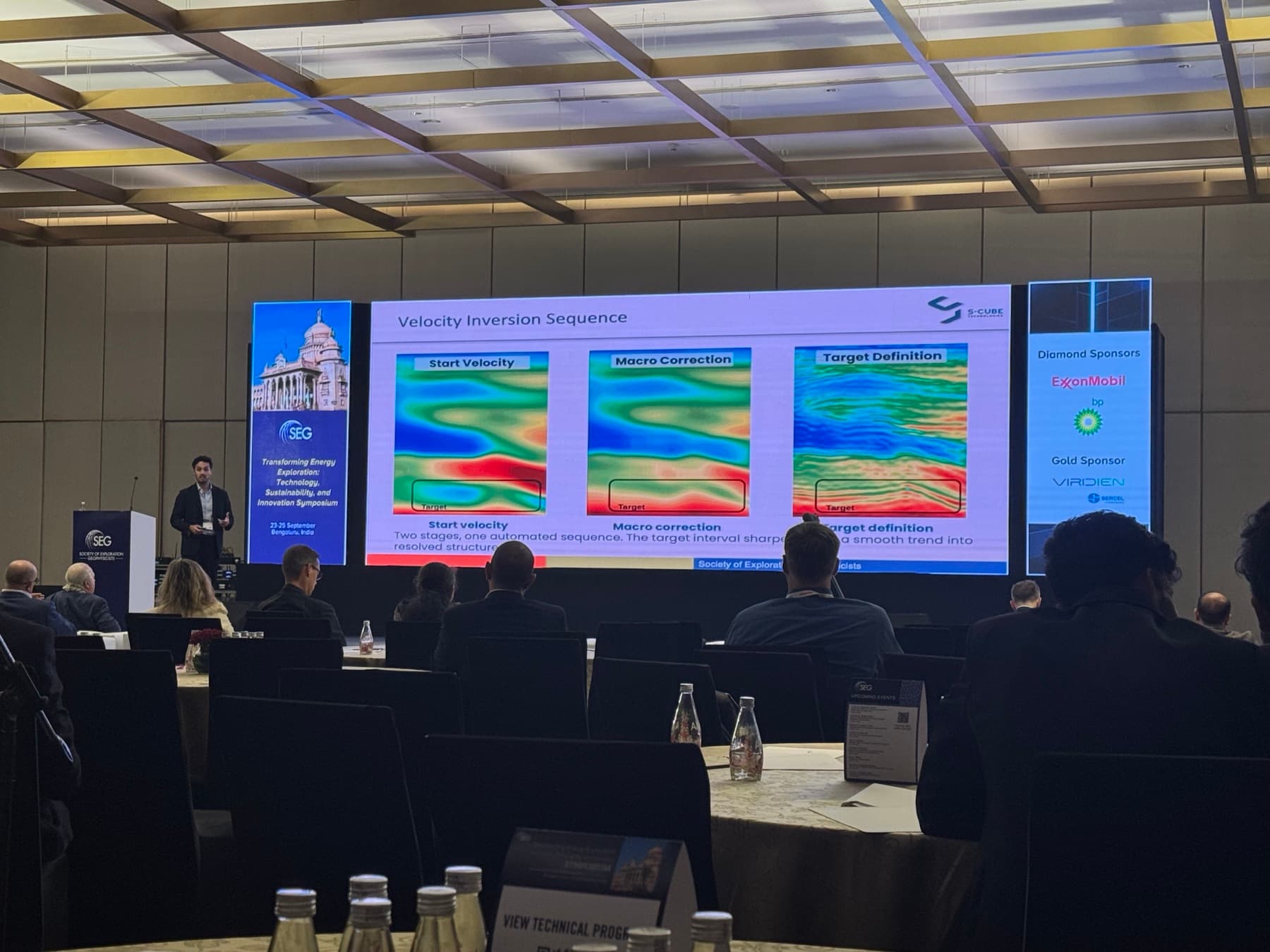
The Bengal Basin data is an older onshore dynamite survey with a thick carbonate layer that distorts imaging of everything beneath it. Land data adds its own problems: near-surface heterogeneity, static shifts, ground roll and limited offsets. Conventional trace-by-trace FWI tends to cycle skip on data like this, when synthetic and recorded waveforms are more than half a cycle apart and the inversion converges to the wrong model.
TSL-FWI™ matches waveforms adaptively across time and space lags instead of sample by sample, so it can start from an inaccurate initial model and still update the deep macro-velocity without long offsets or very low frequencies. On the Bengal Basin survey it:
- corrected deep structural distortions at depths below 6 km;
- updated velocity 4x deeper than the diving-wave penetration limit;
- estimated velocity and reflectivity together from the same inversion;
- did this on existing data, with no re-acquisition.
Offshore Mahanadi Basin: where the collaboration started
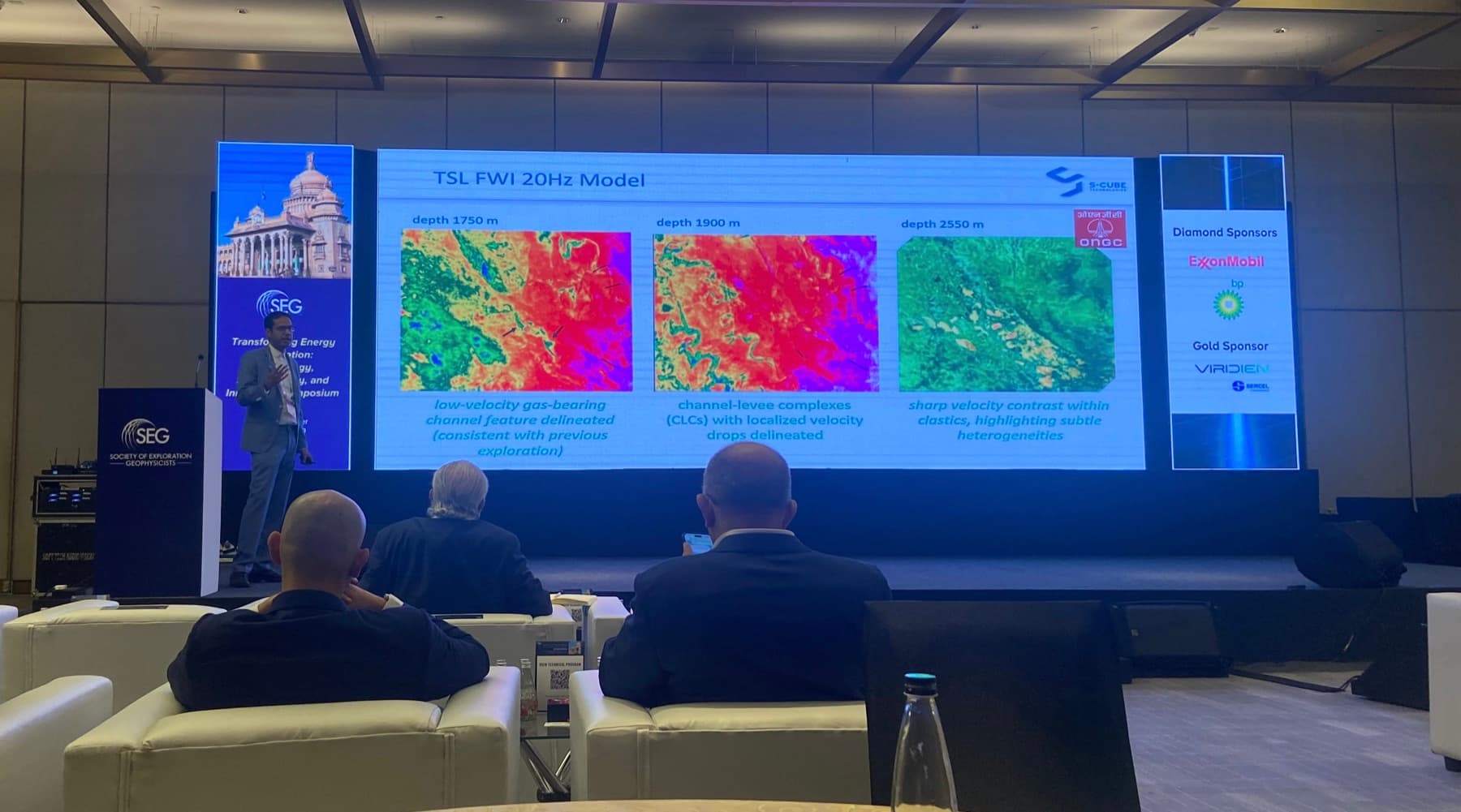
The land project followed S-Cube and ONGC's 2025 work in the deepwater Mahanadi Basin, where the existing streamer velocity model lacked the detail to image key targets. TSL-FWI™ resolved gas-charged Mio-Pliocene channel-levee complexes from scratch, giving a velocity framework for reservoir characterisation.
ONGC's deepwater drilling campaign on this play began in July 2026. In September, ONGC reported gas from the first well, MN-DW18-1-H-D off Odisha, with encouraging flow and reservoir pressure.
What this means for exploration in India
- Legacy land surveys can be re-used: deep velocity updates from older onshore dynamite data extend target depths without new acquisition.
- One method onshore and offshore: the same TSL-FWI™ workflow produced results on Bengal Basin land data and Mahanadi Basin streamer data.
Learn more in our Mahanadi Basin case study and the symposium programme.
Continue Reading
September 25, 2026
Transforming Energy Exploration: Technology, Sustainability, and Innovation Symposium
S-Cube presents four technical talks in Bengaluru on Friday 25 September, including a joint session with ONGC-GEOPIC on land seismic FWI in the Bengal Basin — among the first FWI applications in India with ONGC, spanning both offshore and onshore settings. The talks cover next-generation FWI for land and marine applications and building confidence away from well control with Time-Space-Lag FWI.

June 26, 2026
IMAGE '26: S-Cube presents Time Space Lag FWI for Land and Marine Settings
S-Cube has had two abstracts accepted for oral presentations at IMAGE 2026 in Houston (August 17-20). The talks cover onshore subsalt updates via FWI-Derived-Reflectivity-Driven Reflection Waveform Inversion, and breaking through complex salt by harnessing Time-Space-Lag Adaptive Waveform Inversion together with Reflection Waveform Inversion.

February 5, 2026
S-Cube Named a Top Subsurface Innovator of 2025 by Darcy Insights
S-Cube has been named a Darcy Insights Top 10 Innovator of 2025 for its ML-enabled, cloud-native FWI algorithm. Trusted by majors like Shell, Chevron, and Petrobras, S-Cube delivers high-speed, accurate subsurface imaging in the world’s most complex geological environments.